Saturday, March 2, 2013

If It Makes Money? Why Not?


As mention before the image of model minority that has been given to Asian Americans to their affluence, high education, and professional occupations these aspects of Asian Americans have a negative impact because not Asian Americans are achieving the “American Dream”. In a study from The Asian American Federation revealed that in 2000, nearly 1 in 5 Asians (19.6 percent or 152,674 people) lived below the poverty level and 40.9 percent (318,910 people) lived below twice the federal poverty. (Asian American Federation)

The media has the power to pacify, manipulate, and informed people, in which often times give society misinformation or fraud aspects of race, language, nationality, and culture. The cultivation theory created by George Gorbner and Larry Grass who are researchers at the University Of Pennsylvania, stated that the more time people spend watching television, they develop the perception of social reality portrayed on television. By examining the cultivation theory, the media plays an important role on how society defines the characteristics of racial groups. The stereotype of Model Minority is being portrayed in advertisements that would benefit corporate industries by using Asian Americans to advertise their products. Charles R. Taylor, Stacy Landreth and Hae-Kyong are journalists of Macromarketing (Asian American in Magazine Advertising: Portrays of the Model Minority) conducted a study and revealed that in product categories a consumer responds positively to Asian male in technical advertisements such as laptops and stereo speakers were as in food or men’s suits advertisements it will have negative respond. These studies gives us a better understanding of how themedia uses model minority in there advertisements.


(The Asian American women plays as the car dealer were typically Asian Americans are viewed as talented in engineering field).

Gorbner suggested that when media continues to portray stereotype it would result the acceptance of the stereotype as reality. Grey’s Anatomy series on ABC is an example of media portrays the stereotype of model minority. Sandra Oh who’s character is Dr. Christian Yang, is viewed as ambitious and completive. Although, it shows that Asian Americans are skilled in Science fields continuous portrayals of model minority affect Asians Americans the same point argued by Yuko Kawai who stated the negative aspect made Asian Americans a two faced; that not all Asians Americans were high achieving and successful. This is reason why the media is powerful tool because it could give false representations of ethnic group characteristics.

Friday, March 1, 2013

Why do people still push it?


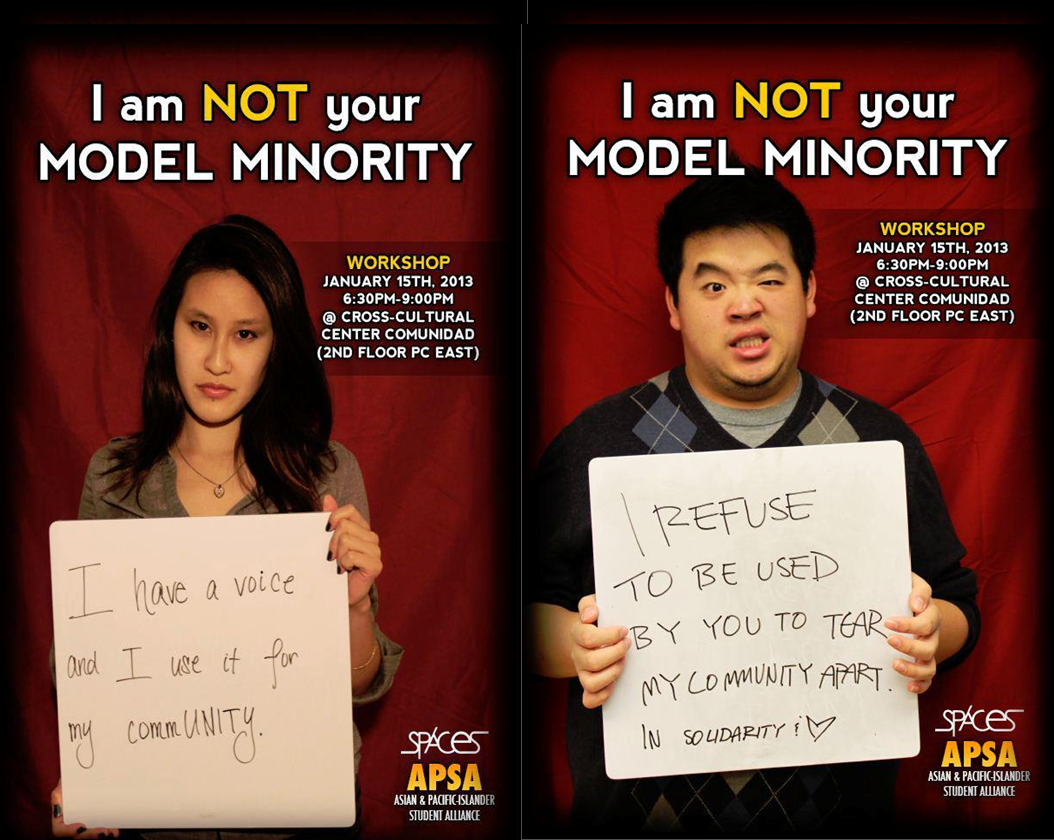
When a person says the “model minority” stereotype is a “good” one, it reflects surface-level and superficial view of the stereotype. The Asian American “model minority” stereotypes, as many people know it, portrays Asian Americans as being very smart, very wealthy, poor at sports, and having high test scores. However, people will explore the stereotype more in depth, he or she soon would realize the negative aspects.

In 2007, a teenage girl committed suicide because she could no longer handle the pressure put upon her to achieve high academic results. She always had a stress over acing the test, getting good grades.This is evidence of how the media’s use of stereotypes can have enough influence to make a person’s life miserable. 
The stereotypes presented in a film can make a person of the stereotyped group feel inadequate, particularly if it is an Asian American who does not fit the ‘model minority’ description.
To some people, a film with stereotypes may be funny and interesting to watch, but to others it can be devastating, especially if a stereotype is degrading. Even if it is not, there can be unreasonable expectations that come with stereotypes such as that of the model minority. The article mentions that people begin to think extremely negative things because they feel as though they cannot live up to others’ expectations; this despair eventually leads them to commit suicide.
If we were to go more in depth, we would realize that once the ideas associated with stereotypes are planted in a person’s mind, it is extremely hard to get rid of them. Despite this, society should try not to apply stereotypes to people, because the effects of these stereotypes can lead to extreme situations.  Therefore, many Asian Americans would strongly disagree, and explain that everyone is different and the stereotype should not be applied. 

Tuesday, February 26, 2013

Myth Busting Model Minority!


Many questions arose for Asian Americans on their achievements such as why are Asian Americans so successful. Authors like Amy Chua states that the reason why Asian kids are successful because cultural and family values play an important role. However, in a video called  "Myth Busting Model Minority Asian Americans Stereotype" Kyung Yoon who is executive director of a Korean American Community Foundation, she emphasizes that not all Asian Americans are working in high skilled occupations there are some who are working in low paying jobs 24/7. Which statistics are shown in an article called “Working but Poor: Asian American Poverty in New York”. In 2000, nearly 1 in 5 Asians lived below the poverty and 40.9 percent lived below twice the federal poverty (in the low income bracket) lower than other ethnic groups (Hispanic and Blacks)(The Asian American Federation 1). Another statistic show that among young adults (age 16 to 24) in New York City, poor and low-income Asians are more apt to be in school and less likely to be disconnected from employment or education that youths of large (The Asian American Federation 1). Additionally, there are many Asian Americans ethnic groups that are not doing well compared to the rest of the U.S population. According to the 2000 census, Cambodians over 90 percent of their population do not have a bachelor’s degree (De Navas-Walt C, et al).  These statistics revealed that not all Asians are high achieving individuals and work in high occupations.

Kyung Yoon further on explains about Asian American adolescents not being supervise or guided at home, the lack of parental care can result in most teenagers joining gangs. Additionally, in a specific scene in Better Luck Tomorrow shows Asian Americans in gang involvement (Darlic, Han, Virgirl and Ben are driving around and a car drive next to them, who are Asian gang members). This film in particular subverts the stereotypes of model minority; were these four Asian Americans are not only high achieving and intellectual individuals but also could be adventurous and notorious individuals.


Monday, February 25, 2013

Image of Model Minority


Many Asian Americans have done a good job in following the American dream, such as getting good educations, good working place, and earn good living. This is how we become the model minority that the society believes for Asian Americans. We are setting up a good example for everyone to look up to. However, do these realities seem way too good to be true? The Socioeconomic Characteristics by Racial Groups chart describes the facts about the education levels and the wages they get between each ethnic group.

            Based on a chart, it stated that Asian Americans earn more than that of White people in America, especially when it gets to college degrees and advanced college degrees. This tells us that through model minority, American dreams are accessible. We should not care about any racial prejudice that people makes in us. Through this, much discrimination are not being made to Asian Americans, such as not requiring to take the bilingual education, government documents in multiple languages, and welfare. However, there are stereotypes that Asian Americans are successful and never struggle. But this is not true. In fact, in order to be successful, hard work was necessary, so there should not be any accusations no more.

            This is significant because the image of model minority is important in today’s society. It affects the nation in economical ways. The power of model minority is the reason how the United States is developing into a more economical country, full of technology for everyday lifestyles. Without this image, the country would turn into turmoil as it is not developing any better. Also, rather than to create a stereotypes of the model minority, we should all be able to respect the Asian cultures of education because it is helping the United States into a greater value.  
 

Sunday, February 24, 2013

We Have Feelings Too.


For many decades Asian Americans have been viewed to be successful and having highly skill professional occupations; given the image of model minority. What society sees are Asian Americans achieving the American Dream but in reality what’s behind that image. Is it a prestigious lifestyle were receiving recognition brings happiness or does it bring a negative image among Asian Americans. Mei Tang from the University Of Cincinnati stated that the model minority myth caused health problems for many Asian Americans (Tang 1). It showed that Asian Americans in school settings found to show lower sense of coherence and have fewer friends than other ethnic groups. Another factor that affects the Asian community, a study discovered that traditional values prevent them from expressing their social and psychological difficulties (Wu 1). Lucian Wang currently a student at Cal State Northridge said that the reason why the model minority myth has effect on many Asian Americans because a lot is expected from them especially from their own parents. He mention his parents always wanted him to achieve success in all his classes and failing to do so would only bring disappointment to his parents and be ashamed of himself. He conclude by saying that most Asian immigrants who came to this country to give their children a better life, expected their children to be successful which gives them pressure.   

The Model Minority myth affects Asian Americans in many ways were society views them highly intellectual people and therefore they have to fulfill that image. As one commented on a YouTube video (being Asian in American Schools) and said “I’m Asian, average, and I don’t go around thinking I'm the best and smartest. I hate it when people look at me sometimes thinking oh shit he’s smart, it pisses me off man”. A short documentary called “Model Minority" explains how the model minority myth has affected many Asian students. One of them explains how his father was a successful dentist and his family wanted him to do something similar but he had no interest in becoming a doctor, engineer, or lawyer, only to follow his dreams. This is an example of Asian Americans feel pressure to be successful because they do not want to disappoint their family.

Wednesday, February 20, 2013

Culture? or Functionalism?


The academic achievements that Asian Americans accomplish are not just because of their cultural values. It is just the behaviors that they follow each day. Stanley Sue and Sumie Okazaki, psychologists, states in Explaining Asian American Academic Achievement ,that through functionalism, Asian Americans are influenced by the opportunities that they are given, which affects not only their educational system, but also their non-educational system as well. Non-educational system includes leaderships, integrity, sports and such. This means that through non-educational system, you develop better educational systems that are needed. Therefore, there is a huge difference between cultures and functionalism, on making a model minority.

This is very significant because there are many stereotypes created through Asian American model minority. However, model minority is not created just because you are a certain race. It is rather the things that you do or believe. I was very interested in what Steinberg (1981) said, which he stated that

“In terms of their European background, Jews were especially well equipped to take advantage of the opportunities they found in America. Had Jews immigrated to an industrial society without industrial skills, as did most other immigrants, their rich cultural heritage would have counted for little. Indeed, a parallel situation exists today in Israel, where Jews immigrating from underdeveloped countries in North Africa typically lack the occupational and educational advantages of the earlier settlers, and despite the fact that all share the same basic religion, the recent immigrants find themselves concentrated at the bottom of Israeli society. Thus, in large measure Jewish success in America was a matter of historical timing. That is to say, there was a fortuitous match between the experience and skills of Jewish immigrants, on the one hand, and the manpower needs and opportunity structures, on the other. It is this remarkable convergence of factors that resulted in an unusual record of success.” (p. 103)

There are many ways you can achieve success, but just cultural heritage alone cannot help gain success.

Stereotypes?Pressure?Media?


Images like these create a negative stereotype for Asian Americans in society; the stereotype that people tend to think Asian parents are strict and pressure their children  to work in high occupations. This image of model minority that has been given to Asian Americans for their affluence, high education, and professional occupations suggests positive aspects about the culture; instead the generalizations and stereotypes about Asian Americans are negative. An article called Stereotyping Asian Americans: The Dialectic of the Model Minority and Yellow Peril by Yuko Kawai , department of English in Tokai University, Japan  he argued the seemingly positive stereotype; model minority is a negative aspect when represented in mainstream media text (Kawai 1). The negative aspect made Asian Americans a two faced; that not all Asians Americans were high achieving and successful. The stereotype of model minority has been used in advertisements, a study shows that a consumer responds positively to Asian male in technical advertisements such as laptops and stereo speakers were as in food or men’s suits advertisements it will have negative respond (Taylor and Stern 1). The reason why it has a positive respond because Asian Americans are viewed as skilled individuals in science, technology, and engineers occupations, convinces the consumer that Asians in any engineering or technical advertisements the products are beneficial. The next following blogs will contribute to my argument on how media uses the model minority stereotype and how it affects the Asian community. 

Work cited

 Asian American Federation. "Working but Poor: Asian American Poverty." C.J Huang Foundation, Ong Family Foundation, United Way of New York City, Oct. 2008. Web. 20 Feb. 2013.

Kawai, Yuko. "Stereotyping Asian Americans: The Dialectic of the Model Minority and the Yellow Peril." The Howard Journal Of Communications, 2005. Web. 19 Feb. 2013.

Taylor, Charles R., and Barbara B. Stern. "Asian-Americans :Television Advertising and the "Model Minority " Stereotype." Journal of Advertising, M.E Sharpe Inc., Summer 1997. Web. 18 Feb. 2013.

Wu, Yue. "MODEL MINORITY STERE OTYPES OF ASIAN AMER ICAN WOMEN IN AMERIC AN MEDIA: PERCEPTIONS A ND INFLUENCES AMONG WOMEN OF DIVERSE RAC IAL - ETHNIC BACKGROUNDS." Zhejiang University, 2008. Web. 21 Feb. 2013

 Taylor, Charles R., Stacy Landreth, and Hae-Kyong Bang. "Asian Americans in Magazine Advertising: Portrayals of the ''Model Minority"" Http://www.sagepublications.com/. SAGE, 12 Dec. 2005. Web. 21 Feb. 2013.

Tang, Mei. "Psychological Effects on Be Ing Perceived as a “Model Minority” for Asian Americans." Chinese American Educational Research & Development Association, 2007. Web. 23 Feb. 2013.